A shared plan for keeping Texas mesh traffic local
This proposal gives every Texas repeater the same set of region scopes, so a message goes as far as its audience and no farther, while statewide traffic still reaches everyone.
Airtime is the one thing the whole mesh shares
Left unscoped, a message floods across every repeater that hears it. That's what you want for an emergency, and a waste for a bot reply. Region scopes let the sender say how far is far enough.
- Local traffic stays local
- Weather alerts for Houston aren't useful in Dallas. With scopes, a message travels as far as its audience and stops, leaving airtime free for everyone else on the channel.
- It costs no airtime
- Region names never go over the air. Packets carry only small transport codes derived from the name, so a repeater can carry its full list of scopes for free.
- Nothing breaks on the way there
- Unscoped traffic keeps flowing on every repeater. Older firmware and nodes that haven't set a scope keep working, so adoption can happen one repeater at a time.
- Everyone uses the same names
- A scope only works across repeaters that all carry the same tag. One statewide plan means traffic doesn't stop at the edge of a group that happened to pick a different name.
Five regions, with metros inside them
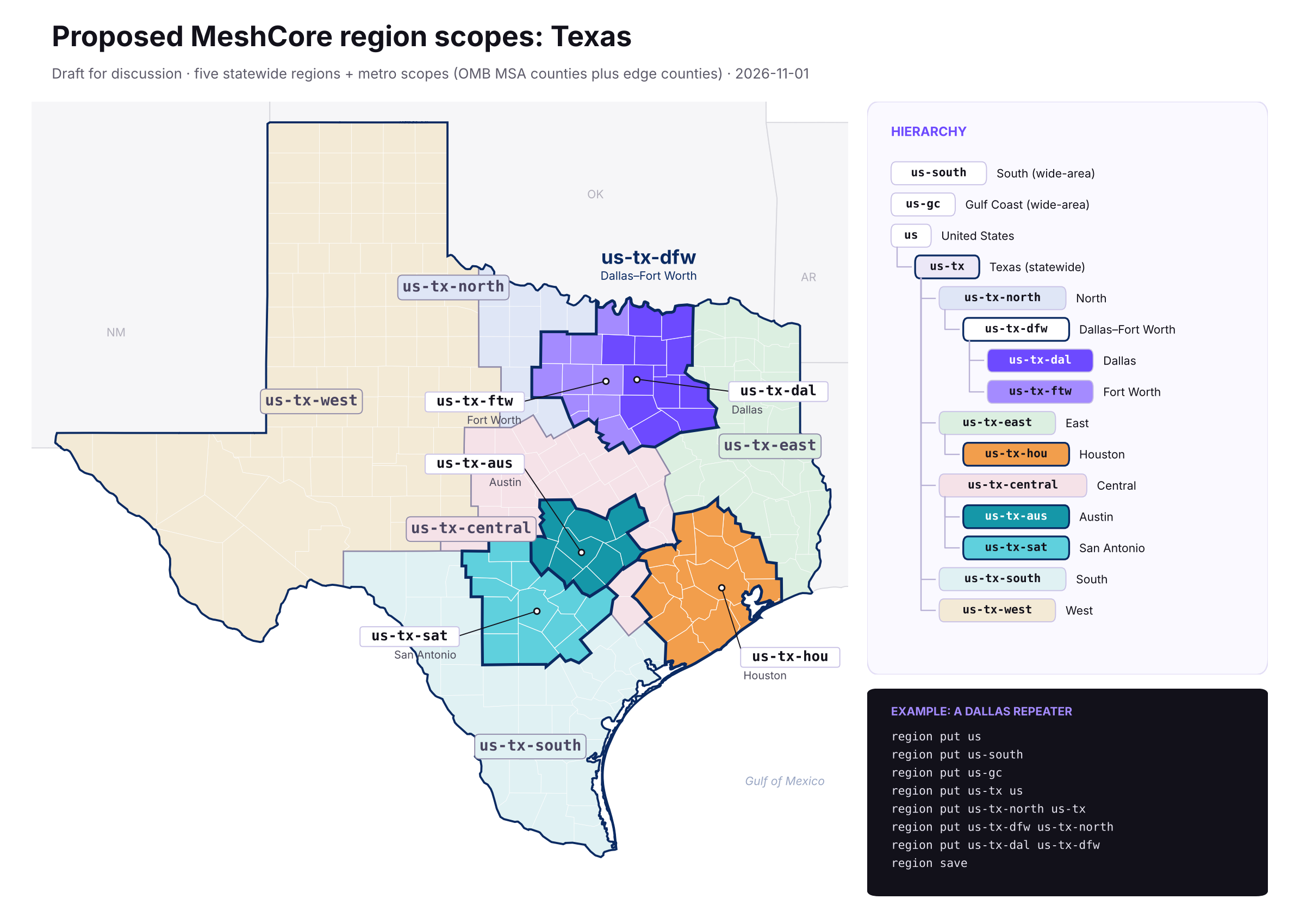
Every county belongs to exactly one of five statewide regions, and each major metro sits under the region that holds it. Areas without a metro scope use their region until a local community asks for one.
Three pieces
- 1
Repeaters carry their place in the hierarchy
Every Texas repeater carries the statewide and wide-area scopes, the one region its county is in, and its metro if it has one. Firmware matches each scope separately, so a repeater with only
us-tx-dalwouldn't forwardus-tx-dfw,us-tx-northorus-txtraffic. It needs every level. - 2
Senders pick the scope, channel by channel
Phones don't hold region tags. Each channel can have its own scope, so a Fort Worth user might keep Public on
us-tx, #weather onus-tx-dfwand #bot onus-tx-ftw. - 3
Traffic goes as far as its scope
That user still sees statewide chat, but doesn't get weather updates or bot output from Austin or Houston. A repeater that doesn't carry a scope doesn't spend airtime forwarding it.
A statewide plan needs the whole state
Nothing here is settled. The more repeater operators and local groups look at it now, the better it fits the mesh we actually have.
Weigh in
Are the right counties in your metro? Should your area have its own scope? The open questions need answers from people who run repeaters there.
Open an issueConfigure a repeater
Enter a ZIP code and get the exact commands. It only adds scopes, so it doesn't change how unscoped traffic moves.
Get your commandsBring it to your group
This works best when neighboring meshes agree. If you're active in a local group, share the proposal and bring back what they think.
Find a local group