
A channel that comes up before the towers do
In the days after a storm, the hard part is rarely the chainsaws. It is knowing which street is blocked, which shelter is full, and where the water actually went, while every normal way of finding out is down.
- usable while carriers are still restoring service
- Day 1
- nodes run for days; solar repeaters run indefinitely
- Battery
- deployable repeaters go up in minutes, anywhere
- Ad hoc
usable while carriers are still restoring service
nodes run for days; solar repeaters run indefinitely
deployable repeaters go up in minutes, anywhere
The problem
Coordination fails before the response does
Power goes first, then the cell sites as their generators run dry, then whatever internet was left. Portable cell infrastructure arrives on somebody else's schedule and lands where the population is densest, not necessarily where your crews are working.
Meanwhile, volunteers are arriving. Roads are blocked in ways no map shows. Two teams clear the same street while another neighbourhood waits three days. None of that is a failure of effort; it is a failure of a communications channel that stopped existing.
What the mesh changes
The network arrives in a backpack
A handful of solar repeaters on high ground, a water tower, a parking garage, a hill, a mast on a truck, plus a node for each team lead. That is a county-scale text network, deployed in an afternoon by people who drove in with it.
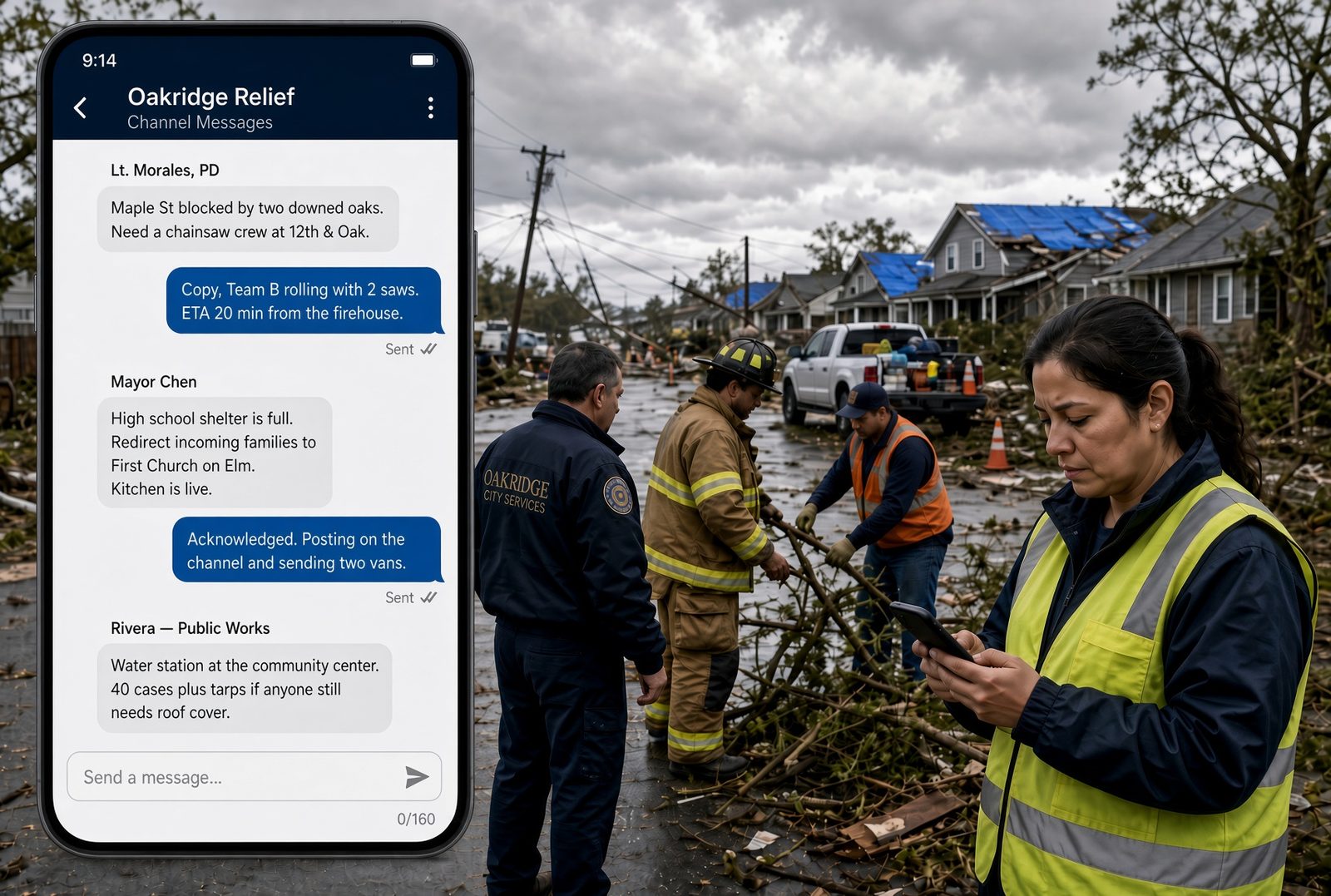
Crews report road blockages with coordinates. Shelters broadcast capacity. Supply runs get routed to where the need is instead of where it was yesterday. All of it encrypted, none of it dependent on infrastructure that is currently underwater.
The best version of this is a mesh that already existed before the storm, because people were using it for ordinary things. Coverage you built in fair weather is coverage you do not have to improvise.
From landfall to a working picture
Volunteer mesh networks are a supplement to official emergency communications, and they are frequently the first thing working on the ground.
Hour 0
Grid and towers drop
Commercial power fails across the county. Cell sites run on generators, then start dropping as fuel runs out and backhaul is lost.
Hour 6
Repeaters go up
Portable solar nodes are mounted on high ground on the way in. Existing fixed repeaters that survived are already carrying traffic.
Day 1
Damage and access reporting
Team leads push blocked roads, downed lines, and damage assessments with positions. A shared picture forms without a single working phone call.
Day 2–7
Sustained coordination
Shelter capacity, water and tarp distribution, crew assignments, and welfare checks run on channels while carriers are still restoring service.
What a working deployment looks like
Go-kit repeaters
Two or three weatherproof solar nodes with mast mounts and straps, pre-flashed and pre-configured, stored ready to grab. Height at the install site is everything.
A node per team lead
Rugged handhelds paired to phones, with spare battery banks. Position reporting on so dispatch can see where crews actually are.
Pre-agreed channels
Channel names, keys, and message conventions decided before the event, printed on a card in the kit. Nobody negotiates protocol at 2 a.m. in the rain.
Set expectations honestly