
Care coordination that survives the outage
Hospitals have generators. They do not always have a working way to talk to the hospital across the county when the fiber is cut, the towers are congested, and the paging vendor is having a bad day.
- dependency on internet, carrier, or vendor uptime
- 0
- to stand up a channel between two facilities
- Minutes
- encrypted end-to-end, on by default
- E2E
dependency on internet, carrier, or vendor uptime
to stand up a channel between two facilities
encrypted end-to-end, on by default
The problem
Every backup channel shares the same failure
Secure messaging apps, paging systems, EHR chat, and the phone tree all ultimately depend on the same things: commercial power, a working internet circuit, and a carrier network that is not saturated. A regional event takes all of them at once, and it takes them exactly when transfer and staffing decisions are most time-sensitive.
Cellular congestion is the underrated failure. The towers are often still standing, they are just full, because every person in the county is trying to use them. Your message does not fail loudly; it just sits there.
What the mesh changes
A channel with no upstream to lose
A MeshCore node at each facility, plus a repeater somewhere high between them, creates a direct text path that does not touch the internet, a carrier, or any vendor. It runs on battery. It does not care that the fiber is cut.
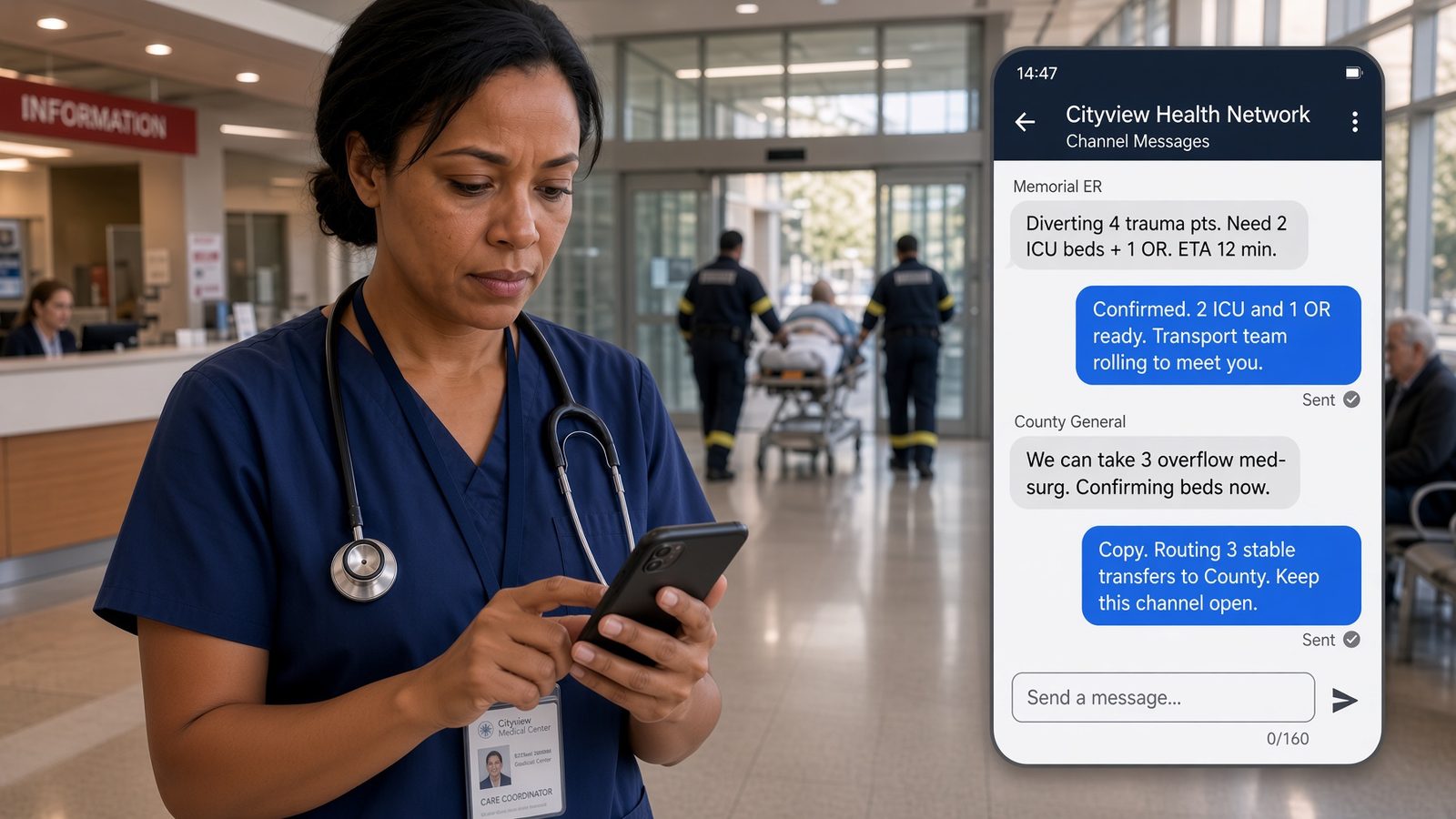
Charge nurses, house supervisors, EMS liaisons, and incident command carry paired handhelds. Bed counts, diversion status, transport ETAs, and staffing calls move on a channel that is up because it was never dependent on anything that went down.
Because messages are end-to-end encrypted, the volunteer-operated repeaters relaying your traffic, including ours, cannot read it. That property is structural, not a promise someone is making you.
The first hour of a regional outage
The value is not that the mesh is better than your normal tools. It is that it is still there.
T+0
Primary channels degrade
Fiber is cut and cell sites saturate. Secure chat stops syncing, pages queue, and outbound calls start failing intermittently.
T+5
Mesh channel comes up
Handhelds come out of the drawer already charged and already paired. The inter-facility channel is live without anyone configuring anything.
T+20
Capacity picture forms
ICU and med-surg availability, OR status, and diversion decisions circulate between facilities as short structured messages.
T+45
Transport coordination
Transfers are matched to receiving beds and routed around blocked roads, with EMS on the same channel rather than a separate phone tree.
What a working deployment looks like
A fixed node per facility
Mounted high, roof, penthouse, or an upper-floor window, on a UPS or battery. This is the anchor that makes everything else reachable.
Handhelds for named roles
House supervisor, charge nurse, EMS liaison, incident command. Assign to the role, not the person, and keep them charged in the same place as the rest of the go-kit.
Written into the continuity plan
Documented channel names, a monthly radio check during normal operations, and a one-page card in the kit. Untested backups are not backups.
Set expectations honestly